


E-Commerce Strategies
Selling online? Here's what you need to know about tax nexus in 2025.
Tax nexus laws determine when you must collect and remit taxes based on your connection to a state. For 2025, key updates include:
Economic Nexus Thresholds: Most states require $100,000 in annual sales, but some (e.g., California, New York, Texas) set higher limits at $500,000.
Transaction Triggers: Many states are eliminating the 200-transaction rule - Alaska (Jan 2025), Utah (Jul 2025), Illinois (Jan 2026).
Marketplace Sales: Even if platforms like Amazon collect taxes for you, those sales may count toward your nexus threshold.
Physical Nexus: Storing inventory in Amazon FBA warehouses can create tax obligations, regardless of sales volume.
Income and Gross Receipts Taxes: Some states tax total revenue or enforce income tax rules once thresholds are met.
Staying compliant means tracking sales, understanding state-specific rules, and registering on time. Ignoring these obligations can lead to penalties and audits.
Pro Tip: Start registering when you hit 80% of a state’s threshold to avoid delays.
What Is Nexus? How Sales Tax Laws Impact Your Business in 2025 with Candy Messer
Sales Tax Economic Nexus Thresholds by State
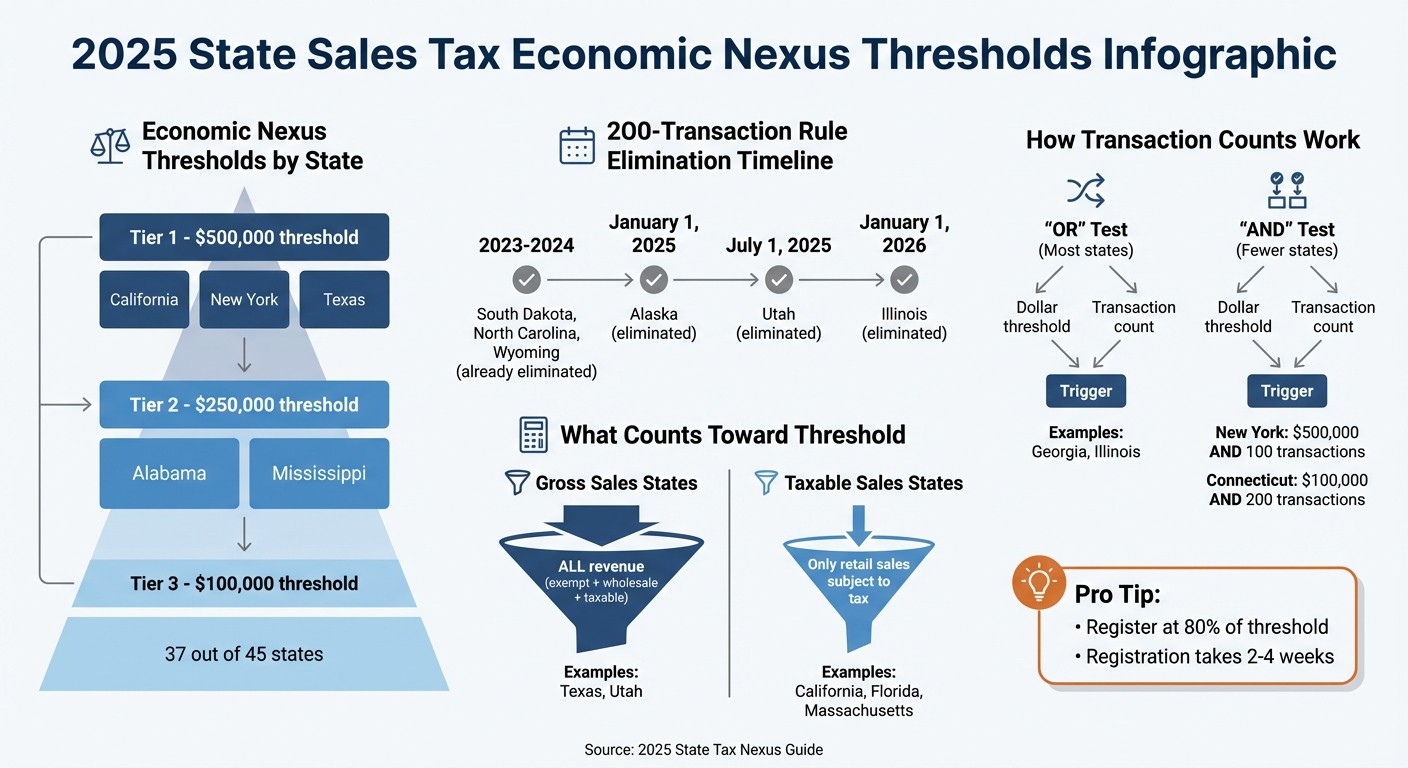
2025 State Sales Tax Economic Nexus Thresholds and Transaction Rules
Standard Sales Thresholds for 2025
For a detailed state-by-state breakdown, refer to our chart that outlines these thresholds clearly.
The majority of states (37 out of 45) set their economic nexus threshold at $100,000 in annual sales. However, some states have higher thresholds: California, New York, and Texas require $500,000, while Alabama and Mississippi set theirs at $250,000.
The time period used to measure sales varies by state, which affects when you’re required to register. For instance, Florida considers only the prior calendar year, so your 2024 sales determine your 2025 obligations. On the other hand, states like Georgia and South Dakota use a "prior or current year" approach, meaning you could trigger nexus during the current year based on sales alone. Meanwhile, Connecticut uses a unique 12-month period ending on September 30, creating a different compliance timeline. Be sure to check the measurement period column in our chart for specifics.
It’s also important to understand what counts toward the threshold. States like Texas and Utah, which use "gross sales", include all revenue - even exempt or wholesale transactions. Meanwhile, states like California, Florida, and Massachusetts, which use "taxable sales", only count retail sales subject to tax. This distinction is critical for businesses dealing with a mix of exempt, wholesale, and taxable retail sales.
Transaction-Based Nexus Triggers
Transaction thresholds are shifting. The 200-transaction trigger will no longer apply in Alaska (starting January 1, 2025), Utah (effective July 1, 2025), and Illinois (beginning January 1, 2026). Other states like South Dakota, North Carolina, and Wyoming already removed this trigger between 2023 and 2024.
Most states that still include transaction counts use an "OR" test - meaning nexus is triggered by exceeding either the dollar threshold or the transaction count. Georgia and Illinois are examples of this. However, New York and Connecticut apply an "AND" test, requiring both conditions to be met. For instance, New York requires $500,000 in sales and 100 transactions, while Connecticut requires $100,000 in sales and 200 transactions.
Sourcing Rules and Their Impact
For remote sellers, destination-based sourcing is the standard. This means your nexus threshold is determined by the location where products are shipped - tracked using the customer’s "ship-to" address. Once you surpass a threshold, you’ll need to collect tax based on the buyer’s local rate, not your own.
Sourcing rules also influence which sales count toward your threshold. For example, states handle digital products and SaaS differently. Some rely on the customer’s billing address, while others consider the server location. This creates added complexity for businesses selling both physical and digital goods. To stay ahead, monitor monthly sales by ship-to state. As a best practice, register with a state as soon as sales hit 80% of its threshold, since registration typically takes 2–4 weeks.
The next sections will cover income, franchise, and gross receipts tax nexus, along with filing deadlines, to help you prepare for 2025 compliance requirements.
Income, Franchise, and Gross Receipts Tax Nexus
Gross Receipts Tax Thresholds
States don’t just stop at sales tax; many also tax businesses on their overall revenue. Several states impose a Gross Receipts Tax (GRT), which applies to total in-state revenue, including exempt and wholesale sales. For example, New Mexico requires businesses with gross receipts exceeding $100,000 to register and file returns, even if a marketplace facilitator collects the tax for them. On the other hand, Delaware bases its GRT on physical presence rather than a monetary threshold. States like Washington and Ohio also use a $100,000 revenue threshold. While GRT may allow exclusions for intercompany sales, the specifics of these exclusions vary widely depending on the jurisdiction.
Franchise and Income Tax Nexus
Many states now go beyond traditional physical presence requirements for income and franchise taxes by using "factor presence" standards. These standards rely on specific thresholds for property, payroll, and sales to establish tax obligations. For instance, states like California, New York, and Texas often set a $500,000 sales threshold to trigger nexus. However, physical property or payroll within the state can also create obligations, regardless of sales volume. Much like sales tax sourcing rules, income and franchise tax obligations depend on both physical and economic presence. Even inventory stored in FBA (Fulfillment by Amazon) warehouses can trigger these obligations, no matter the sales volume.
"If physical nexus exists, register and pay income, sales, net worth, or payroll taxes in that state even if your revenue there is small." - Diane Kennedy, CPA, USTaxAid
It’s worth noting that Public Law 86-272 offers some protection against state income tax for businesses whose only activity is soliciting orders for tangible personal property. However, this law doesn’t shield businesses from sales tax, franchise tax, gross receipts tax, or taxes on services and digital goods. States are becoming more aggressive in auditing businesses claiming this protection, particularly focusing on online activities like cookies, chat tools, and account logins.
Effective Dates and State Variability
Economic nexus laws for income and franchise taxes often apply retroactively once thresholds are exceeded. For example, Washington transitioned from a retail sales standard to a gross income standard starting January 1, 2020, while Illinois plans to implement a gross receipts threshold of $100,000 beginning January 1, 2026. Additionally, many states use sales tax registration as a reason to investigate income or franchise tax obligations. It’s also crucial to monitor the locations of remote employees - just one employee working from home in a different state can immediately trigger income and payroll tax requirements in that state.
State Filing Frequencies and Deadlines
Filing Frequencies by State
How often you need to file sales tax returns depends on how much tax you collect each month. States generally set thresholds to determine whether you file monthly, quarterly, or annually:
Monthly filing: Typically required when your tax collections exceed $300 to $1,000 per month.
Quarterly filing: Designed for businesses with moderate tax collections.
Annual filing: Reserved for businesses collecting less than $100 in tax monthly.
For instance, California mandates monthly filing for sellers collecting $10,000 or more in tax per quarter, while Texas requires it for collections of $1,500 or more per quarter. In Florida, the threshold for monthly filing is $1,000 or more in tax per month. These thresholds vary by state, and your filing frequency may change annually based on actual sales tax collections.
"The actual registration is the easy part. Knowing WHEN to register and HOW OFTEN to file - that's where the real decisions are." - SmartSMSSolutions
Even if platforms like Amazon collect and remit taxes on your behalf, you may still need to file zero returns. Missing a filing deadline - even for a zero return - can result in penalties starting at $50 and escalating to 5%–25% of unpaid taxes. States closely monitor filings to ensure compliance, so timely submissions are essential.
Once you determine your filing frequency, review your registration deadlines to avoid penalties for late registration.
Registration Deadlines
After figuring out how often you need to file, the next step is understanding when to register. Registration deadlines differ significantly by state:
Arkansas and Georgia: Register before your next transaction after hitting the threshold.
California: Register on the same day you exceed the threshold.
New York: Offers a 30-day window to register.
Colorado: Requires registration by the first day of the month after a 90-day grace period.
Other states set deadlines tied to the calendar year. For example, Alabama requires registration by January 1 of the year after you exceed the threshold, while Florida mandates registration by the first day of the next calendar year. In Arizona, registration is required by the first day of the month starting at least 30 days after crossing the threshold.
Most states process online registrations within 1 to 3 weeks, so it’s wise to start registering once your sales hit 80% of a state’s threshold. If you’re nearing the threshold during Q4, registering by September can help ensure you’re ready to collect tax when required.
Marketplace Facilitator Impacts
Marketplace facilitator laws simplify tax collection for sellers using platforms like Amazon, but they also introduce new considerations. All 45 states with a sales tax, plus Washington D.C., now require marketplace facilitators to collect and remit tax for you. This can make compliance easier for FBA sales but more complex if you sell through multiple channels.
Some states - like California, New York, Texas, and Washington - include marketplace sales when calculating economic nexus thresholds. Others, such as Alabama, Florida, and Illinois, exclude marketplace sales. This distinction matters if you sell both through Amazon and directly via platforms like Shopify. You could exceed a threshold based on total sales but only be responsible for collecting tax on your direct sales.
Even if Amazon handles all your sales tax, many states still require you to register and file zero returns. Additionally, some states enforce a "trailing nexus" rule, meaning you must continue filing returns for 1 to 4 quarters after your sales drop below the threshold. Monitoring your sales monthly and keeping track of which states Amazon handles versus those requiring your direct involvement is critical for staying compliant.
These filing and registration rules lay the groundwork for navigating more complex tax compliance strategies in the coming years.
2025 Updates and Compliance Strategies
Major State-Specific Changes for 2025
Starting in 2025, 15 states are eliminating the 200-transaction threshold, making compliance a bit easier. Alaska led the way on January 1, 2025, followed by Utah on July 1, 2025. Illinois plans to implement this change on January 1, 2026.
"Transaction counts add complexity without much benefit... The solution: drop transaction counts, use sales-only thresholds." - SmartSMSSolutions
States are also expanding their tax bases. For instance, Louisiana began taxing Software as a Service (SaaS) on January 1, 2025, while Maryland introduced a 3% tax on IT services starting July 1, 2025. Additionally, new retail delivery fees are now in play. Colorado introduced a $0.28 fee per qualifying delivery in July 2025, while Minnesota applies a $0.50 fee on orders exceeding $100. These changes highlight the importance of monitoring sales channels, delivery methods, and product categories. Staying on top of these updates is critical for businesses to remain compliant.
Conducting a Nexus Study
With these changes, it’s essential to reassess your tax obligations by conducting a nexus study. Start by exporting 12–24 months of sales data, broken down by ship-to state, and compare it against the latest thresholds. Pay close attention to states where you have physical nexus, such as FBA warehouses or remote employees, as these create tax obligations regardless of sales volume. For Amazon sellers, check monthly reports to see where your inventory is stored, since FBA placement can establish physical nexus even if economic thresholds aren’t met.
To simplify tracking, use a "traffic light" system:
Green: Sales below 75% of the threshold
Yellow: Sales between 75–99% of the threshold
Red: Sales exceeding the threshold
If you’re approaching a threshold, especially during Q4, aim to register by September to ensure permits are ready before peak sales hit. For any past obligations, consider a Voluntary Disclosure Agreement (VDA) to limit the look-back period to 3–4 years and potentially waive penalties.
How eStore Factory Supports Sellers

As these tax requirements evolve, eStore Factory offers account management services to help sellers navigate compliance. They monitor state-specific thresholds, filing deadlines, and FBA inventory placement while integrating sales data from platforms like Amazon and Shopify. This proactive approach ensures sellers register in the right states ahead of time.
Conclusion
Understanding state tax nexus rules in 2025 is critical for protecting your profit margins. As Yash Bodane from Webgility explains:
"That tax bill you didn't see coming? It just reduced your profit margin by 15%."
With all 45 states enforcing economic nexus laws, sellers can no longer afford to overlook these thresholds. Ignoring them opens the door to significant financial risks, making a well-thought-out compliance strategy essential.
The provided chart serves as a practical guide, outlining the key thresholds and deadlines you need to know to steer clear of penalties. One important takeaway? Even sales collected by marketplaces like Amazon count toward your nexus threshold. This is a common pitfall for Amazon sellers, as marketplace sales often trigger tax obligations for other platforms like Shopify or your own website.
Another layer of complexity comes from physical nexus through FBA warehouses. Where Amazon stores your inventory can create tax obligations, no matter how much you sell. This is especially crucial during Q4, when inventory is frequently redistributed, making it vital to track warehouse locations monthly.
Compliance isn’t a one-and-done task - it requires ongoing vigilance. Tools like eStore Factory’s account management services can simplify this process by monitoring state-specific thresholds, tracking FBA inventory, and consolidating multi-channel sales data. This proactive approach helps ensure timely registrations and minimizes compliance risks.
FAQs
Do my Amazon marketplace sales count toward nexus thresholds?
Yes, sales made through the Amazon marketplace usually contribute to reaching nexus thresholds. In many states, these transactions are factored into the total sales volume that determines your economic nexus obligations. It’s essential to check the specific regulations in each state to ensure you meet all compliance requirements.
What establishes physical nexus when using Amazon FBA?
When you use Amazon FBA (Fulfillment by Amazon), it creates a physical presence, or nexus, in any state where your inventory is stored or fulfilled. This physical presence often means you're required to collect and remit sales tax, depending on the specific tax rules in that state. Each state has its own regulations, so understanding where your inventory is located is crucial for staying compliant.
When should I register before I hit a state’s threshold?
You should register before reaching a state's economic nexus threshold. This threshold is typically determined by surpassing certain sales or transaction limits within a defined period, like the previous calendar year. Taking action early ensures you steer clear of potential non-compliance penalties.






