


E-Commerce Strategies
Selling products in Saudi Arabia? Here's what you need to know about the Product Certificate of Conformity (PCoC):
What is PCoC? A mandatory certification proving your product meets Saudi technical and safety standards. Issued via the SABER platform, it's valid for one year.
Why is it required? Without a PCoC, your goods can't clear customs. Since January 1, 2025, Saudi Arabia enforces a dual-certification system requiring both a PCoC and a Shipment Certificate of Conformity (SCoC) for imports.
Does your product need it? Check your product's HS code on SABER to determine if it's regulated. High-risk items may also require additional certifications, like the Saudi Quality Mark (QM).
How to get it? Your Saudi importer must register the product on SABER, select a SASO-approved certification body (CAB), and submit technical documents, including ISO/IEC 17025-accredited lab test reports.
Costs and penalties: Certification costs range from $5,000 to $15,000+, depending on product type and risk level. Non-compliance can lead to shipment rejections, fines starting at $6,700, and even market bans.
Key takeaway: Ensure your products meet Saudi standards to avoid costly delays or penalties. Always work with your importer and a trusted CAB to streamline the process.
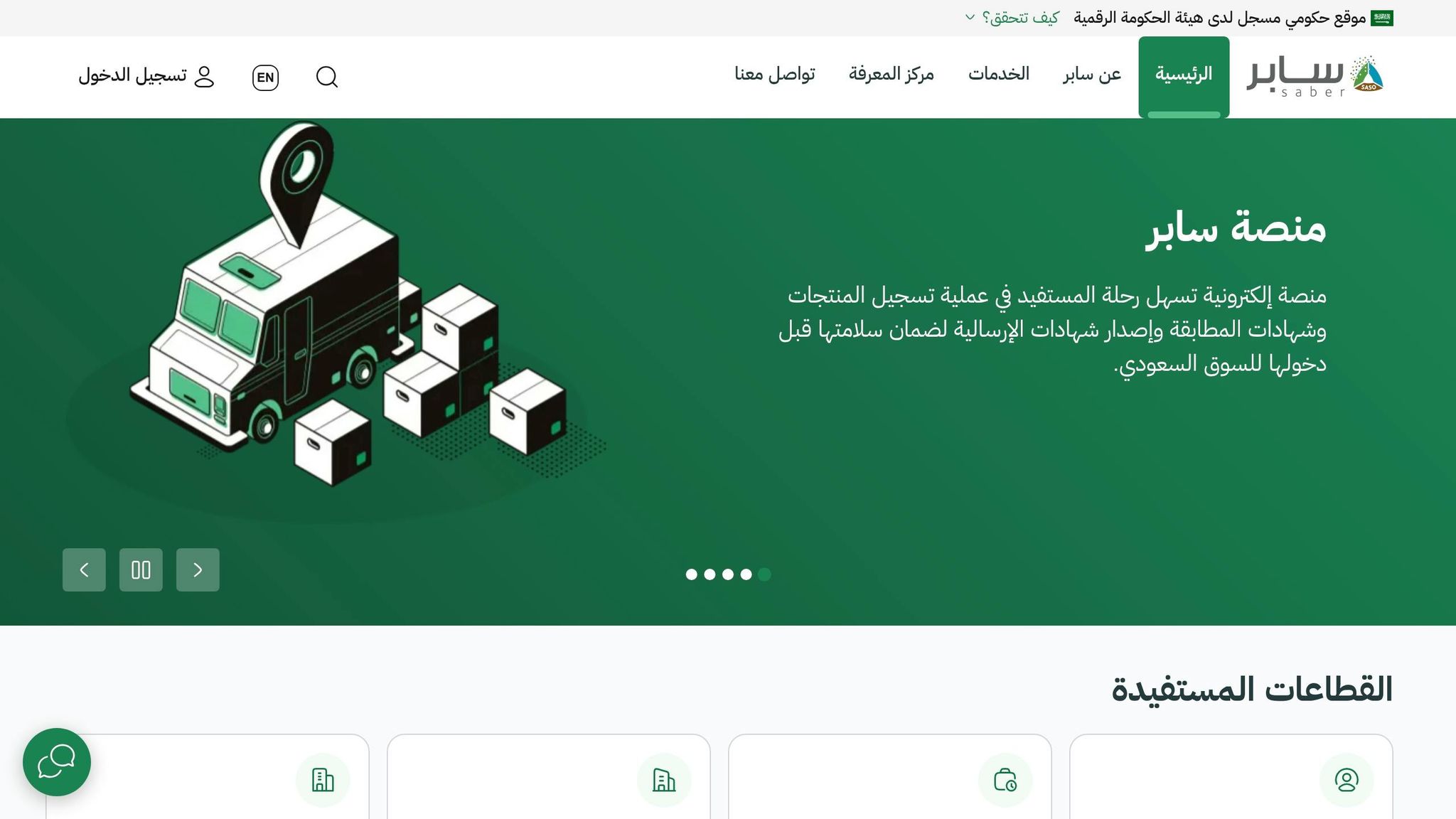
SABER Registration Saudi Arabia (2025) | Step-by-Step Guide
How to Determine if Your Product Needs PCoC
Not all products entering Saudi Arabia require a PCoC. The deciding factor? The HS code. This six-to-ten-digit classification code determines whether your product is regulated, unregulated, and which certification path applies.
Finding Regulated Products Using HS Codes
On SABER, entering the HS code quickly identifies if your product is regulated. It also shows the applicable Saudi Technical Regulations (TRs) and whether you’ll need a PCoC or the Saudi Quality Mark (QM).
Before starting your application, double-check your HS code. Using the wrong code can lead to mismatched regulations, rejections, or delays. Confirm the correct HS code with your Saudi importer, as they must register the product and HS code on SABER first. Once that’s done, you’ll need to provide technical files and test reports to your chosen Certification Body.
Don’t overlook the classification of all components, including accessories. This step helps prevent potential customs issues.
When the HS code confirms regulation, check the product's risk category to understand any additional certification requirements.
Understanding Product Risk Categories
After confirming your product’s regulated status through the HS code, the next step is to evaluate its risk category. The HS code determines if your product falls under categories like electrical safety, toys, construction materials, or cosmetics. Each category comes with specific documentation needs.
For regulated products, a PCoC is required. This certificate is issued by a third-party Certification Body after a thorough technical review. On the other hand, unregulated products follow a simpler self-declaration process on SABER to generate shipment documents.
If your product is higher-risk - such as high-power electrical equipment - it may also need a QM in addition to the PCoC. This requires more detailed testing and factory inspections. Always keep SABER updated to stay on top of current requirements.
How to Obtain PCoC Certification

Saudi Arabia PCoC Certification Process: 4-Step Guide for Sellers
If your product's regulation has been confirmed, the next step is obtaining your PCoC certification. Here's how you can navigate the process.
The PCoC certification process is managed entirely through SABER, Saudi Arabia's official online conformity system. Since January 1, 2025, SABER requirements have applied to all commercial imports into the Kingdom, covering approximately 10,000 HS codes. The process includes four key steps, with your Saudi importer playing a central role from the beginning.
Step 1: Register on SABER
Your Saudi importer must handle the initial registration on SABER using a valid Saudi Commercial Registration (CR). They will also need to assign a communication officer to oversee uploads and manage activities on the platform.
Once the importer registers, account verification typically takes 24–72 hours, following OTP or email confirmation. After verification, the importer registers your product details. This step is critical because SABER uses this information to determine the relevant technical regulations and identify the Certification Bodies (CABs) that can certify your product.
After completing product registration, the next step is to select an approved CAB.
Step 2: Choose an Approved CAB
Once the product is registered, the importer selects a SASO-approved Conformity Assessment Body (CAB) - such as SGS or TÜV - through SABER. The platform only displays CABs approved for your specific product.
The importer then pays the required fees via SABER to initiate the certification request. The selected CAB receives the application electronically through their SABER portal and coordinates directly with you (the exporter) to gather necessary documents. Ensure that your laboratory test reports, technical drawings, and other substantiating documents are prepared before this step, as the CAB will request them immediately.
Timely submission of documents is essential to avoid delays.
Step 3: Submit Required Documents
You’ll need to provide a complete technical file, which includes datasheets, specifications, schematics, and ISO/IEC 17025-accredited test reports. Clear photos of the product, packaging, and required labels must also be included.
Make sure the ISO/IEC 17025 accreditation logos on your test reports are clearly visible. Missing or unclear accreditation is a common reason for rejection. The CAB will review your submissions to confirm compliance with Saudi Technical Regulations and may request additional testing or clarification if there are any gaps. During this phase, monitor your SABER dashboard regularly to address any CAB requests promptly.
Step 4: Receive Your PCoC
Once the CAB approves your submission, SABER issues a digital PCoC with a QR code. The certificate is automatically linked to your importer’s account and is valid for one year. The time it takes to issue the PCoC can vary, ranging from a few days to several weeks, depending on the completeness of your documentation and whether additional testing is required.
With the PCoC in hand, Shipment Certificates (SCoC) can be issued for each consignment. These are typically processed within 24 to 48 business hours after you submit the shipping documents. The electronic linking ensures customs authorities can instantly verify your product’s compliance at the border.
Required Documents for PCoC Application
Once you've completed the application steps, the next important task is gathering all the necessary documents.
Having a fully prepared technical file is crucial to avoid delays or rejections. The Conformity Assessment Body (CAB) will require these documents as soon as your Saudi importer initiates the application. Being prepared ensures a smoother process.
Laboratory Test Reports
Your product must include test reports from an ISO/IEC 17025 accredited laboratory. These reports are essential for proving compliance with the Saudi Technical Regulations and SASO standards relevant to your product category. It's important that the test parameters align specifically with Saudi technical standards, not just general international ones. For instance, if you're certifying an electrical appliance, the reports need to cover areas like voltage, safety, and energy efficiency according to Saudi requirements. Before submission, confirm that the laboratory is recognized by Saudi authorities to avoid issues during SABER registration.
Product Specifications and Technical Drawings
Detailed product information is a must. The CAB will review your product’s design, dimensions, materials, and functional components. This technical documentation is critical for verifying your manufacturing process and ensuring the product adheres to safety and quality standards.
Supplier's Declaration of Conformity
This is a formal statement from you, the manufacturer or exporter, affirming that your product complies with all applicable Saudi regulations and standards. It must include key details like product information, applicable standards, test report references, and your company’s details. While the CAB helps coordinate the collection of this document, your Saudi importer is responsible for submitting it through SABER. Accuracy and completeness are vital, as this document supports the entire certification process and assists customs officials in verifying compliance at the border.
With these documents in place, your CAB can thoroughly assess your product and issue the PCoC, ensuring a smoother certification journey.
Renewing PCoC and Obtaining SCoC
After obtaining your initial PCoC certification, staying compliant means keeping up with renewals and verifying each shipment. Your PCoC is valid for one year from the date it’s issued, so you’ll need to renew it annually.
How to Renew Your PCoC
Start the renewal process early to avoid delays or extra fees. Before applying, ensure your technical documentation is up-to-date. Check that your manufacturing site’s ISO 9001 certificate is still valid and that your product photos meet the December 2024 requirement of providing three high-resolution images per item. Additionally, confirm that your test reports align with the latest SASO standards - such as the shift for electrical products from IEC 60950-1 to IEC 62368-1.
Not all products from the previous year need renewal. Focus on renewing certificates for items that are in high demand. This strategy helps you save on certification costs for products that are slow sellers or no longer in production.
Once your PCoC is renewed, you’ll need to acquire an SCoC for each shipment to ensure compliance.
How to Get SCoC for Each Shipment
After renewing your PCoC, the next step is obtaining an SCoC for every shipment. The Shipment Certificate of Conformity (SCoC) is mandatory for all regulated products entering Saudi Arabia. It confirms that the items in a shipment are backed by valid PCoCs. Your Saudi importer will request the SCoC through the SABER platform, typically using the same Conformity Assessment Body that issued your PCoC. The process usually takes 2–3 working days once the shipment is ready and all PCoCs are verified.
Before requesting an SCoC, double-check that every product in the shipment has an active PCoC. For instance, if you’re shipping 10 regulated items, all 10 must have valid certificates in the system. Ensure the HS codes on your SCoC match those on your PCoC. To avoid delays, plan for the entire certification process to take about 3–4 weeks, allowing for smooth customs clearance.
Costs and Penalties for Non-Compliance
Certification Fees
The cost of certifying your products varies based on several factors. These include SABER registration and issuance fees, CAB charges, accredited lab testing costs, and, if needed, factory audit expenses. To manage your budget effectively, it's a good idea to request a detailed fee estimate from your SASO-approved CAB.
The complexity of your product also affects both the cost and the time required for certification. Simple products can usually be certified within 2–3 weeks, while more intricate items, like complex electrical goods, may take 6–8 weeks. Keep in mind that PCoCs (Product Certificates of Conformity) are specific to each importer. This means if multiple entities are importing the same product, each one must cover separate certification fees.
Consequences of Non-Compliance
Non-compliance isn't just a financial inconvenience; it comes with serious risks. If you fail to certify your products or provide proper documentation, you could face steep penalties. Saudi Customs has the authority to reject your shipment, leaving you responsible for 100% of the return freight or destruction costs. Financial penalties for violations start at SAR 25,000 (around $6,700) and can reach up to SAR 1,000,000 (around $267,000) for serious infractions. Additionally, while your goods are detained at the port, storage and demurrage fees pile up daily, potentially costing you thousands more.
But the consequences don't end there. SASO has the power to take more severe actions, such as delisting your products or suspending your access to the Saudi market entirely. Repeated violations could even lead to being blacklisted, effectively barring you from doing business in Saudi Arabia for the long term. Even minor issues, like mismatched documentation, can result in SCoC (Shipment Certificate of Conformity) rejections and costly port delays. When you add up these "hidden" costs, it becomes clear that compliance is always the more affordable option in the long run.
Conclusion
What Sellers Need to Remember
To sell regulated products in Saudi Arabia, securing and maintaining a PCoC (Product Certificate of Conformity) is essential. Start the process by confirming your product's HS code on the SABER platform. Once verified, register on the platform, choose a SASO-approved CAB (Conformity Assessment Body), and submit all necessary documents, including lab test reports and product specifications from accredited sources.
Keep track of your PCoC’s one-year validity to prevent customs delays. Also, remember that every shipment requires an SCoC (Shipment Certificate of Conformity) in addition to a valid PCoC.
Before diving into the certification process, determine if your product needs the Saudi Quality Mark (SQM), which follows a separate procedure. For food and pharmaceutical items, compliance with the Saudi Food and Drug Authority (SFDA) standards is mandatory, along with general SASO requirements. These specific regulations highlight the need for thorough compliance planning.
The costs of non-compliance - such as rejected shipments, return freight, fines starting at $6,700, and daily port fees - can significantly outweigh the investment in certification. Staying compliant not only avoids these expenses but also builds trust in the market. By meeting all requirements, you safeguard your market access, enhance your supply chain efficiency, and ensure uninterrupted business operations in Saudi Arabia.
Partnering with an approved CAB and keeping your technical documentation updated will simplify the certification process. Beyond avoiding penalties, compliance paves the way for a stable and efficient presence in one of the Middle East's most vital markets.
For professional assistance in navigating the compliance process, eStore Factory offers expertise to help you expand your reach in international markets.
FAQs
Can I apply for a PCoC myself without a Saudi importer?
No, you can’t apply for a Product Certificate of Conformity (PCoC) without working with a Saudi importer. The process requires a partnership with a Saudi importer or a local representative to handle registration and compliance through official platforms like SABER. Both foreign exporters and Saudi importers play a role in ensuring the product aligns with Saudi Arabia's safety and conformity standards.
What causes PCoC or SCoC applications to be rejected on SABER?
Applications for PCoC (Product Certificate of Conformity) or SCoC (Shipment Certificate of Conformity) on the SABER platform often face rejection due to compliance mistakes. Common issues include incomplete or incorrect documentation and not meeting shipment requirements.
To improve your chances of approval, make sure to:
Submit complete and accurate documentation.
Obtain all necessary regulatory approvals.
Complete required pre-shipment verifications.
The SABER platform conducts a thorough compliance review before approving shipments. Proper preparation is key to avoiding delays or rejections.
How do I handle PCoC if I sell the same product through multiple Saudi importers?
Each shipment or batch of your product needs a separate Product Certificate of Conformity (PCoC), even if the product is distributed through multiple Saudi importers. Since the PCoC is linked to individual shipments, every importer is responsible for ensuring their own compliance and certification. If your product is already registered on the SABER platform, the local importer must manage the registration process and secure the PCoC to prevent delays or complications at customs.






